Houthi Missile Hits Aramco HQ, Brent Nears $107 as Bitcoin Awaits US CPI
Author: Crypffalo Research · 12:57 14/10/2026
A Houthi missile struck Aramco's Dhahran headquarters, sparking a limited fire, and Brent rose to about $107. Bitcoin holds near $83,300 ahead of the US CPI report at 12:30 UTC.

A Houthi missile struck Saudi Aramco's headquarters complex in Dhahran late on Oct 13 local time. Saudi Arabia's Energy Ministry confirmed a "limited fire" and said there were no injuries or deaths.
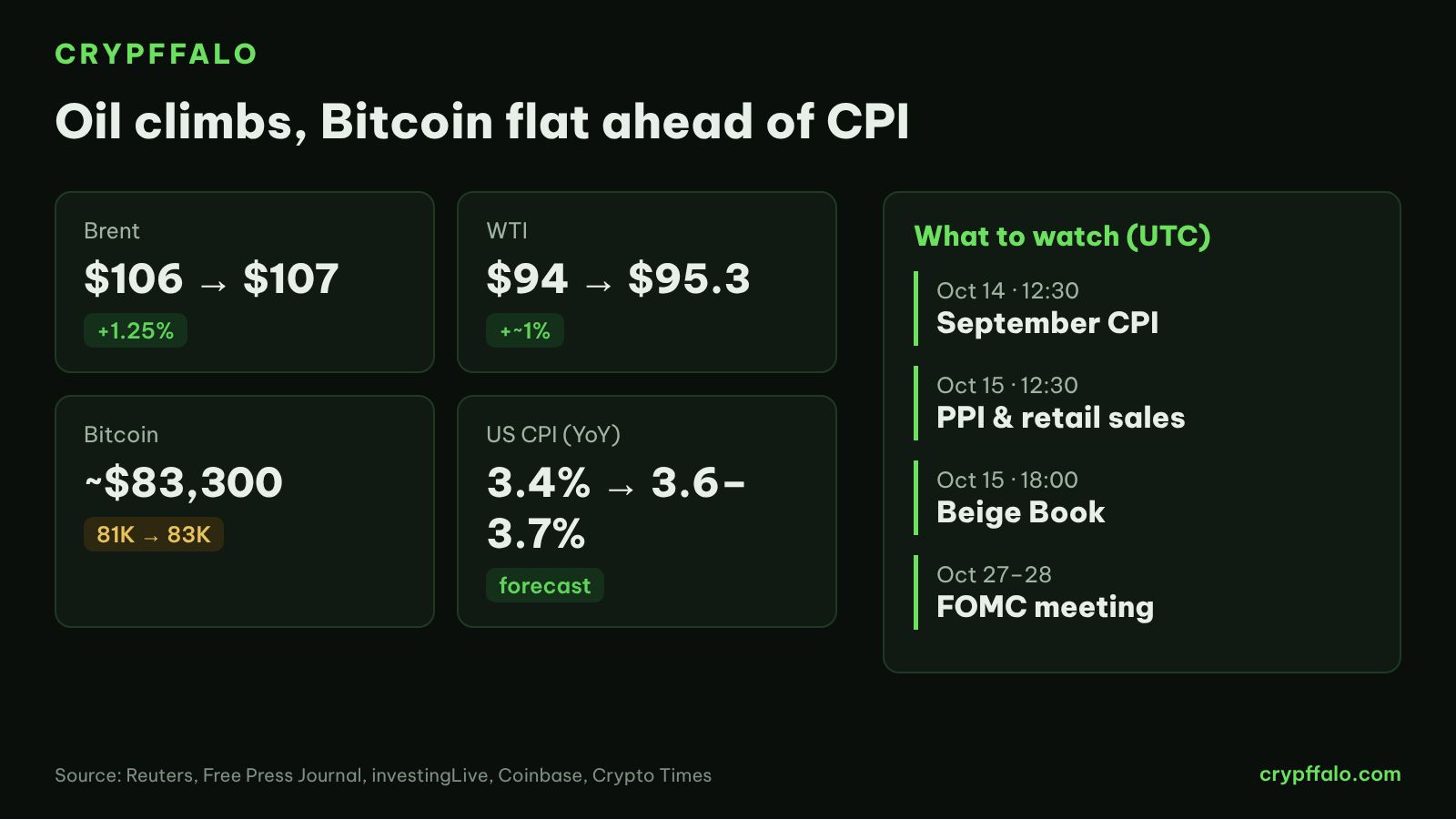
Brent crude rose about 1.25% to roughly $107 a barrel in Asian trading on Oct 14. Bitcoin barely reacted, holding near $83,300 as traders turned their focus to the US CPI report due at 8:30 a.m. ET.
Key takeaways
- The strike: A Houthi ballistic missile hit Aramco's Dhahran complex, damaging the top three floors of an office tower, according to a company source cited by Reuters.
- Damage: The Saudi Energy Ministry reported only a limited fire and no casualties; the full extent of the damage has not been disclosed.
- Oil: Brent traded near $107 and WTI near $95.30 on the morning of Oct 14 (GMT+7).
- Bitcoin: Hovering around $83,300, still below the $83,600–$84,000 resistance zone.
- Main event today: September US CPI lands at 12:30 UTC, with headline inflation expected to rise to 3.6%–3.7%.
What happened in Dhahran
Six sources told Reuters they heard loud booms near the Aramco headquarters. A company source said a missile hit the complex and damaged the upper floors of an office building.
The Saudi-led coalition said fragments of an intercepted missile fell on a residential area of Dhahran. Bloomberg noted it remains unclear whether the site took a direct hit or was struck by debris, and Aramco has not commented.
The attack is part of an escalation that has run for about a week:
- The Houthis have fired missiles and drones at key Saudi sites in retaliation for Riyadh's support of Yemen's government.
- Riyadh's international airport has been hit four times; Saturday's strike killed 13 people.
- The Jazan refinery has been shut since an earlier attack.
- Just before the Dhahran strike, the coalition hit an oil station in Sanaa, and the Houthis vowed a "harsh and painful" response, naming Aramco's headquarters as a target.
Oil and the inflation picture
The oil market was already tight. The US-Iran war that began in late February led to the closure of the Strait of Hormuz, and crude pushed above $100 earlier this month.
On Oct 13, Brent settled near $106 and WTI near $94. After the Dhahran news, Brent added about 1.25% to $107 while WTI rose to around $95.30.
High energy prices are feeding into US inflation. Forecasts compiled by Crypto Times and Cryptoticker point to September CPI rising to 3.6%–3.7% year over year from 3.4% in August, driven mostly by gasoline.
The Fed raised rates in September, and many officials still leave the door open to another hike before year-end. New York Fed President John Williams said one more increase this year "could be appropriate," though he does not currently expect further hikes in 2027.
What it means for crypto markets
Bitcoin has shown some resilience, recovering from $81,000 to around $83,300 despite rising oil and a steep selloff in South Korean stocks on Oct 13. Still, price remains capped below $83,600–$84,000, suggesting buyers are waiting for the CPI print.
- Bull case: A CPI reading at or below forecasts, especially a stable core figure, could ease pressure for an October hike and help BTC retest $84,000.
- Risk case: A hotter-than-expected CPI combined with further oil gains could lift Treasury yields, pull BTC toward the $81,000–$82,800 support area and trigger liquidations.
The US 10-year Treasury yield is already near 5.19%. A prolonged energy shock would make it harder for the Fed to ease, a headwind for risk assets like crypto.
What to watch next
- Oct 14, 12:30 UTC: September US CPI.
- Oct 15, 12:30 UTC: US PPI and retail sales.
- Oct 15, 18:00 UTC: Fed Beige Book.
- Oct 27–28: Next FOMC meeting.
- Responses from Riyadh and Washington, and Iran's offer to mediate between Saudi Arabia and the Houthis.
Track release times on our economic calendar and position wipeouts on real-time liquidations.
Frequently Asked Questions
Why do oil prices affect Bitcoin?
Higher oil lifts inflation, giving the Fed a reason to hold or raise rates. Higher rates tend to reduce demand for risk assets like crypto.
Has Aramco's oil production been disrupted?
So far only a limited fire at an office building has been confirmed, with no reports of production outages. Further attacks on production sites or export terminals would raise supply risks.
What time is the US CPI release?
September CPI is released at 8:30 a.m. ET on Oct 14, which is 12:30 UTC or 7:30 p.m. in Vietnam.
*This content is for information only and is not financial advice.*
Tags: Oil, Geopolitics, CPI, Bitcoin, Fed
Related articles
- Mt. Gox Delays Bitcoin Repayment Deadline to Oct 2027, 34,400 BTC Still in Wallets
- France Votes 31.4% Tax on Crypto-to-Stablecoin Swaps by a Single Vote
- Bitcoin ETFs pull in $526.7M as BlackRock files for downside-protected BTC ETF
- Strive buys 4,045 BTC for $335 million, lifts Bitcoin holdings to 36,818 BTC
- Strategy buys 267 BTC, spends $193M on STRC buyback, lifts limit to $3B
- China Q3 GDP beats forecasts at 4.5%, Bitcoin rebounds to $82,500