Google cuts quantum errors 40x on Willow chip, sharpening Bitcoin's quantum risk
Author: Crypffalo Research · 21:54 17/10/2026
Google says a new technique cuts magic-state errors about 40-fold on its Willow chip. There is no imminent threat to Bitcoin, but pressure to move to post-quantum cryptography is building.

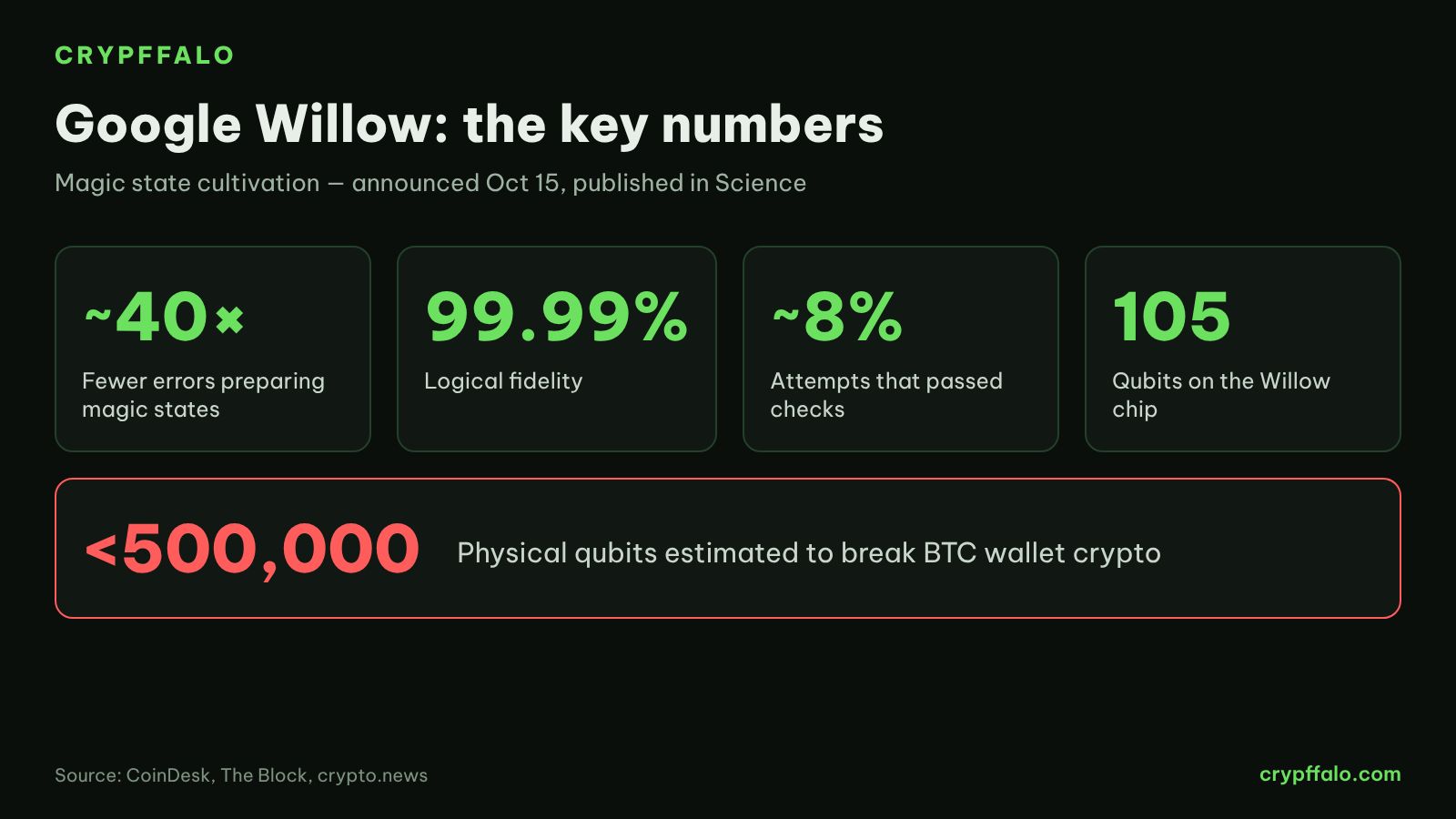
Google has unveiled a new milestone on its Willow quantum chip: a technique called "magic state cultivation" that cuts errors roughly 40-fold when preparing so-called magic states. These states are a key resource for advanced quantum computations, including the algorithm that could one day break Bitcoin's digital signatures.
The result was announced on Oct 15 (US time) and published in the journal Science. Markets barely reacted, with BTC hovering around $81,400, but analysts say Bitcoin's post-quantum clock is ticking faster.
Key takeaways
- The news: Google cut magic-state errors about 40x on its 105-qubit Willow processor.
- Accuracy: States that passed inspection reached roughly 99.99% logical fidelity.
- Bitcoin risk: A March Google estimate said a machine with fewer than 500,000 physical qubits could break Bitcoin and Ethereum wallet cryptography.
- Right now: There is no imminent threat, as today's machines are far from that scale.
- Price: BTC sits near $81,400, down about 0.9% in 24 hours, with no sell-off tied to the news.
What Google achieved
Magic states are the raw material for logic gates that standard error-corrected quantum hardware cannot perform on its own. By some estimates, producing them could consume up to 95% of a quantum computer's capacity.
Cultivation starts with a rough state, checks it for errors and discards flawed attempts. According to CoinDesk, only about 8% of attempts survived the checks, but those that did were highly accurate.
Research scientists Emma Rosenfeld and Craig Gidney described it as the first experimental demonstration of an efficient way to produce these resources on real hardware. Google also said the technique still needs testing at larger scales.
Why Bitcoiners are paying attention
Bitcoin relies on elliptic-curve signatures (ECDSA and Schnorr). In theory, a powerful enough quantum computer could derive a private key from a public key already exposed on the blockchain.
The most vulnerable coins are early Satoshi-era holdings and wallets that reuse addresses, since their public keys are already visible. Many early owners may have lost their keys, so they cannot move those coins into stronger protections.
Notably, CoinDesk stressed that the result does not make an attack on Bitcoin 40 times cheaper. It solves one engineering step, while scaling up remains a major challenge.
What experts are saying
- Nic Carter (Castle Island Ventures): There is no imminent threat, but this is another sign that quantum progress is accelerating.
- Alex Pruden (Project Eleven): The technique was already assumed in earlier estimates, so it validates those timelines rather than moving Q-day forward.
- Coinbase: On Oct 13 it published recommendations for Bitcoin's post-quantum transition, urging the community to prepare early for a multi-year process.
What it means for crypto markets
The news has not moved prices in a visible way. BTC continues to trade sideways between $81,000 and $82,000 after a week weighed down by hot CPI and PPI data and high oil prices.
- Bull case: Pressure from Google's progress pushes developers to converge sooner on proposals such as BIP-360, reducing long-term risk.
- Risk case: Each new quantum headline could revive fears about old coins, especially when long-dormant wallets suddenly move.
Bitcoin still has no network-wide deadline for adopting post-quantum signatures, and what to do with Satoshi-era coins remains a contentious debate.
What to watch next
- Bitcoin developer discussions around BIP-360 and post-quantum wallet designs.
- Larger-scale demonstrations from Google and rivals such as IBM.
- Movements from long-dormant wallets.
- Next week's macro data on the economic calendar and real-time liquidations.
Frequently Asked Questions
Can quantum computers break Bitcoin today?
No. Today's machines have around 105 qubits, while estimates call for hundreds of thousands of reliable physical qubits.
Which coins are most at risk?
Coins whose public keys are already exposed on-chain, such as early coins or reused addresses. Wallets that use a fresh address for each transaction expose far less.
What is BIP-360?
It is a proposed new output type designed to reduce public-key exposure, as a step toward a post-quantum Bitcoin.
*This content is for information only and is not financial advice.*
Tags: Bitcoin, Quantum, Google, Security
Related articles
- Mt. Gox Delays Bitcoin Repayment Deadline to Oct 2027, 34,400 BTC Still in Wallets
- Bitcoin ETFs pull in $526.7M as BlackRock files for downside-protected BTC ETF
- Strive buys 4,045 BTC for $335 million, lifts Bitcoin holdings to 36,818 BTC
- Strategy buys 267 BTC, spends $193M on STRC buyback, lifts limit to $3B
- JPMorgan Brings JPM Coin Deposit Token to Ethereum Mainnet, Beyond Coinbase's Base
- China Q3 GDP beats forecasts at 4.5%, Bitcoin rebounds to $82,500